
Colebee and Nurragingy
Colebee and Nurragingy were Aboriginal men, acting as guides, accompanied Governor Macquarie’s soldiers on punitive raids as guides. Nurragingy was from the Eastern Creek and South Creek area. Colebee was from the Richmond area, the son of Yarramundi, a karadji (doctor) of the Burraberongal people.
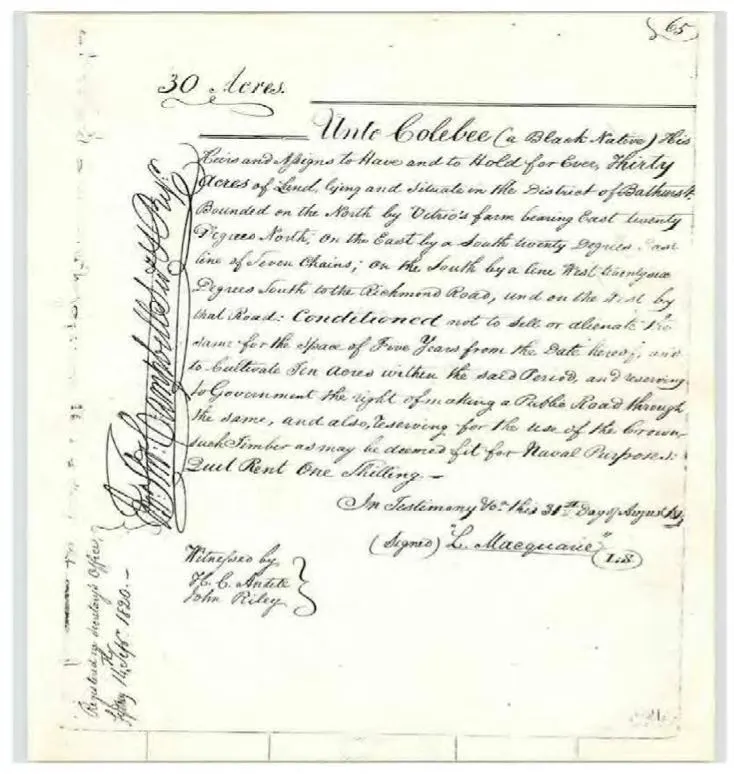
Following the expedition of 1816, which culminated in the Appin massacre, Macquarie presented Nurragingy, who was also called Creek Jemmy, with a breastplate inscribed ‘Chief of the South Creek Tribe’. In recognition of their involvement in the expeditions, Macquarie jointly granted Colebee and Nurragingy 30 acres of land, in 1819.
This grant (located at the intersection of present day Rooty Hill Road North and Richmond Road) is widely recognised as the first colonial land grant given to Aboriginal People in Australia, and is listed on the NSW State Heritage Register.
The grant’s location held particular significance as it represented an Aboriginal-led decision—the land belonged to Nurragingy’s traditional clan territory. It encompassed important sites including “Iron Bark Range”, an elevated campsite that provided protection from Eastern Creek floods and access to silcrete stone.
Colebee did not remain on the grant for long, but Nurragingy settled there permanently, cultivating crops and raising livestock.
Following the deaths of both Colebee and Nurragingy, two of Nurragingy’s sons and Colebee’s younger sister, Maria Lock, claimed the land in 1843. Since the grant was registered only in Colebee’s name, ownership passed to Maria. She and her husband Robert moved onto the property with their ten children and later expanded their holding by acquiring an adjacent 30-acre plot originally granted to Sylvanus Williams.
When Maria died in 1878, her nine surviving children inherited the 60-acre property, which was divided amongst them. The Locke family maintained their residence there until approximately 1917, when the Aborigines Protection Board compulsorily acquired the land. The Board subsequently sold the property following World War II.
DHARUG NURA Blacktown Native Institution Conservation Management Plan 2024 and “Colebee and Nurragingy Land Grant”. New South Wales State Heritage Register. Department of Planning & Environment. H01877. Retrieved 2 June 2018. Text is licensed by State of New South Wales (Department of Planning and Environment) under CC BY 4.0 licence.
- 4 Church St, Rooty Hill NSW 2766
- Call us (02) 9748 9800
- Get directions via Google
